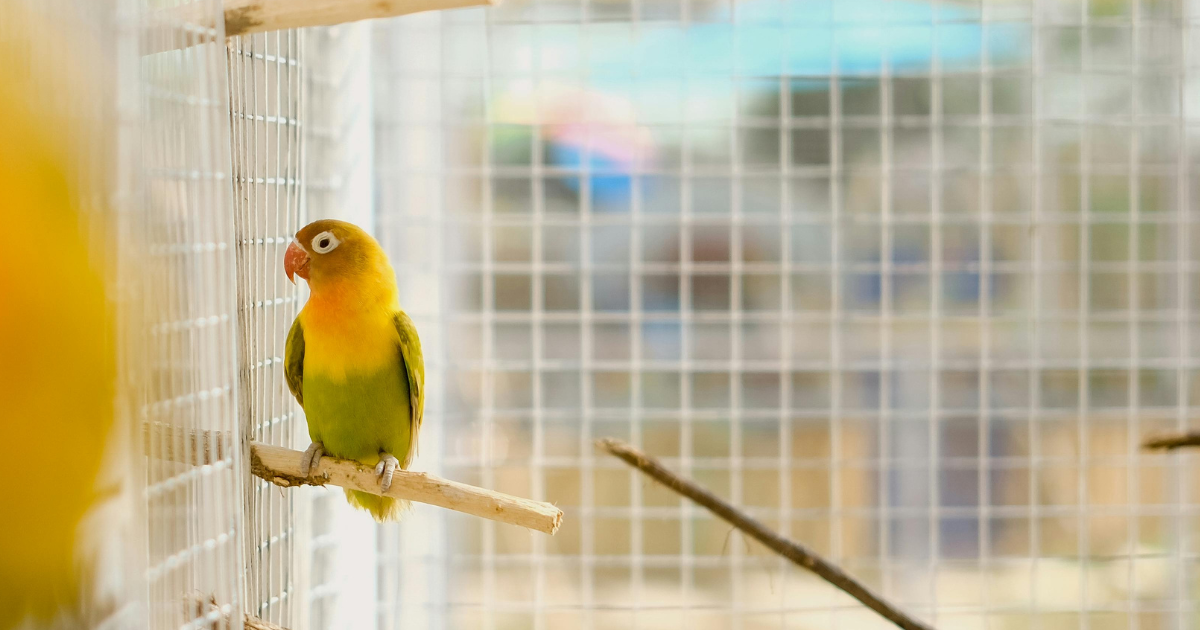
“What size cage does my bird actually need?”
Choosing a cage can be one of the biggest decisions you'll make when bringing a bird home and it's easy to focus on the cage that fits your space rather than the cage that best fits your bird.
The most important thing to remember is that there isn't one cage size that is right for every bird. Your bird's species, wingspan, number of birds, how much time they spend outside the cage and how the cage is furnished all matter. And when it comes to cage size, bigger is generally better.
Cage requirements vary by species, but the RSPCA recommends using wingspan as an important measurement. For birds that spend most of their time outside the cage, the cage's height, width and depth should each be at least 1.5 times the bird's wingspan. If your bird spends most of its time in the cage, each dimension should be at least twice its wingspan.
Out-of-cage time is important, but it doesn't make a tiny cage suitable. Your bird still needs enough room to move, stretch, perch and behave naturally while inside its cage.
Table of Contents
Why does cage size matter so much?
A cage isn't just somewhere your bird sleeps.
For many pet birds, it's also where they:
- Eat
- Drink
- Rest
- Preen
- Play
- Climb
- Forage
- Interact with their environment
Birds are naturally active animals. Flying is one of their main ways of moving around, and being confined to a space that's too small can prevent them from carrying out normal behaviours.
The RSPCA advises that a bird's cage should contain enough uncluttered space for them to flap their wings as often and as hard as they want to.
A larger cage also gives you more flexibility to provide appropriate perches and enrichment without filling the entire living space.
How do I work out the right cage size?
One of the most useful measurements is your bird's wingspan the distance from the tip of one fully extended wing to the tip of the other.
The RSPCA recommends:
If your bird spends most of its time outside the cage:
Height × width × depth should each be at least 1.5 times the bird's wingspan.
If your bird spends most of its time in the cage:
Height × width × depth should each be at least twice the bird's wingspan.
This is useful because it moves the conversation away from simply saying: “A budgie needs a cage this size.”
Instead, you're considering the actual bird and how they're going to use the space.
One important point
These should be treated as minimum guidance, not a target to aim for if you have the option to go bigger.
If you have room for a larger suitable cage, we'd encourage you to use it.
Does the shape of the cage matter?
Yes. For most birds, usable horizontal space is particularly important.
A very tall, narrow cage might look impressive, but if your bird can't move comfortably from side to side or stretch its wings without hitting toys and perches, you're not making the best use of that space.
When comparing two cages, ask: “How much usable space will my bird actually have?”
rather than: “Which cage has the biggest number on the box?”
A wider cage can often provide much more useful movement and flying space than a narrow tower-style cage.
Does bigger always mean better?
Generally, yes, provided the cage is still appropriate and can be furnished safely.
A larger cage gives your bird more room to:
- Move around
- Stretch
- Flap
- Climb
- Explore
- Play
- Forage
- Move away from another bird
- Choose where they want to perch
But there's an important caveat.
Don't fill a huge cage with so many accessories that your bird loses its usable space.
This is one of the most common mistakes we see.
A cage can be physically large but functionally small if it's packed with:
- Toys
- Swings
- Perches
- Huts
- Food bowls
- Ladders
- Accessories
Your bird should still have clear, uncluttered areas where it can stretch and flap its wings.
What about bar spacing?
Bar spacing is just as important as cage size.
The gaps between the bars need to be appropriate for your bird.
If the bars are too far apart, a small bird may be able to squeeze its head through or potentially escape.
If they're too close together for a larger bird, the cage may not be suitable or comfortable.
Bar thickness and strength also matter, particularly for larger parrots with powerful beaks.
Bird Cage Size Guide: What Size Cage Does My Bird Need?
Cage requirements vary between species, and bigger is always preferable where you have the space. The table below gives the UK minimum dimensions for a single bird to allow flight, based on the bird's average wingspan.
| Bird | Average wingspan | Minimum cage length | Minimum cage depth | Minimum cage height |
|---|---|---|---|---|
| Budgerigar | 30 cm | 60 cm | 45 cm | 45 cm |
| Canary | 22 cm | 44 cm | 33 cm | 33 cm |
| Zebra Finch | 22 cm | 44 cm | 33 cm | 33 cm |
| Lovebird | 28 cm | 56 cm | 42 cm | 42 cm |
| Cockatiel | 48 cm | 96 cm | 72 cm | 72 cm |
| Small Parakeets & Conures | 35 cm | 70 cm | 53 cm | 53 cm |
| Large Parakeets, Conures & Small Macaws | 70 cm | 140 cm | 105 cm | 105 cm |
| Amazon Parrot | 60 cm | 120 cm | 90 cm | 90 cm |
| African Grey | 70 cm | 140 cm | 105 cm | 105 cm |
| Small–Medium Cockatoo | 75 cm | 150 cm | 113 cm | 113 cm |
| Large Cockatoos & Macaws | 110 cm | 220 cm | 165 cm | 165 cm |
Where should I put my bird's cage?
Even the perfect cage can become a poor home if it's positioned badly.
Choose somewhere that gives your bird a good balance of security, interaction and stability.
The RSPCA recommends placing the back of the cage against a solid wall, which can help birds feel more secure.
Avoid placing the cage:
- Directly beside a radiator
- Near a fire or stove
- In a draught
- In a busy doorway
- Where it can easily be knocked
- In a kitchen where it may be exposed to cooking fumes
Read our guide: Is My Bird Too Cold? How to Keep Your Pet Bird Comfortable as Autumn Arrives
What about putting it by a window?
A window can provide natural light and interesting things for your bird to see, but don't place the cage where your bird is exposed to cold draughts or direct sunlight that could cause overheating.
You'll also need to consider whether your bird becomes stressed by activity outside.
What if my bird can't fly?
Birds that cannot fly because of disability or other circumstances have different needs.
The cage should be adapted so that the bird can climb and move safely between food, water and resting areas without needing to fly.
Does my bird still need time outside the cage?
Yes. A bigger cage does not replace the opportunity to fly and explore safely outside it.
Out-of-cage time provides opportunities for:
- Flight
- Exercise
- Exploration
- Social interaction
- Enrichment
- Mental stimulation
Before letting your bird out, make sure the room is safe. Doors and windows should be closed, mirrors and large windows should be made safe, and ceiling fans should be switched off.
So why can't I just buy a small cage and let my bird out all day?
This is a really common question.
You might think: “If my bird gets six hours of free flight, surely the cage doesn't need to be very big?”
Your bird still needs somewhere appropriate to:
- Sleep
- Eat
- Drink
- Rest
- Preen
- Play
- Move around
- Stretch and flap
And you won't necessarily be able to provide exactly the same amount of out-of-cage time every single day.
There may be times when your bird needs to stay inside because you're working, cleaning, have visitors, have other pets around or simply need to make the room safe.
A suitable cage gives your bird a good quality environment even when the cage door is closed.
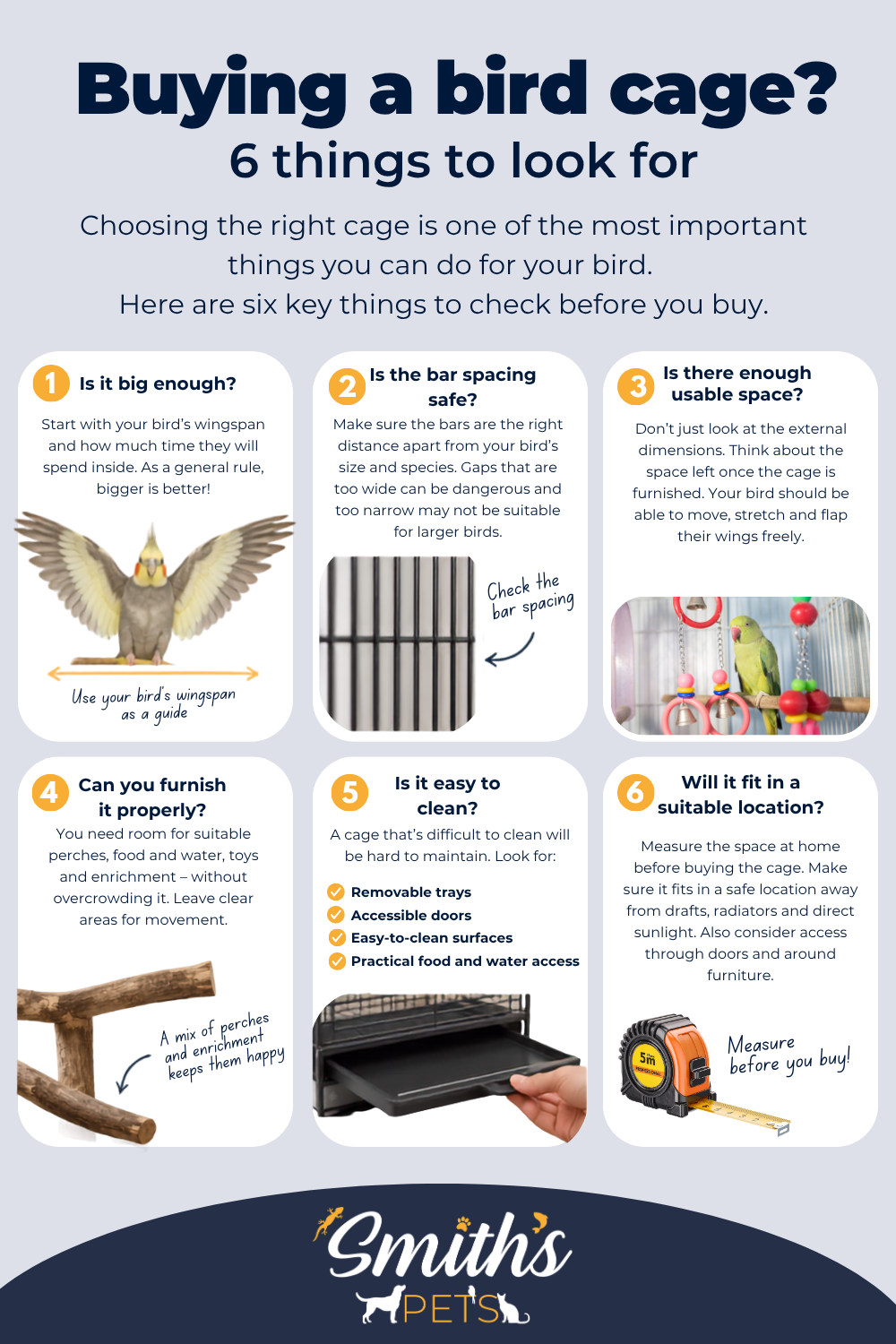
Common cage-buying mistakes
❌ Choosing the cage based on the bird's body size
Your bird's wingspan and ability to move are much more useful considerations than simply how long their body is.
❌ Buying the smallest cage that fits the budget
A cage is a long-term investment in your bird's welfare.
❌ Choosing height over usable space
A very tall, narrow cage isn't necessarily better than a wider cage that allows more natural movement.
❌ Filling the cage with toys
Enrichment is important, but your bird still needs clear space to move and stretch.
❌ Assuming out-of-cage time makes a small cage acceptable
It doesn't. Your bird needs an appropriate home even when they're inside.
❌ Forgetting bar spacing
A cage can be large enough but still unsafe if the bars aren't appropriate for your bird.
❌ Buying the cage before checking where it will go
Measure your available space, doorways and access routes first.
What we recommend at Smith's Pets
When choosing a cage, we'd always rather help you find the right cage for your bird than simply sell you the biggest cage on the shelf.
The right choice depends on:
- Your bird's species
- Their wingspan
- Whether they're housed alone or with compatible birds
- How much time they'll spend outside the cage
- The space you have available
- The enrichment and perches you plan to use
And if you're choosing a cage for a new bird, don't choose the cage first and then try to make your bird fit it. Start with the bird. Think about how they naturally move, how much space they need and what their daily life will look like. Then choose the cage that gives them the best environment you can provide.
Frequently Asked Questions
Does a bigger cage mean I don't need to let my bird out?
No. A large cage is better than a small one, but it doesn't replace regular opportunities for safe flight and exploration. Pet birds need opportunities to exercise and behave naturally outside their cage too.
Is a round cage suitable for birds?
We'd generally recommend a practical cage that provides good usable space rather than choosing a cage based on appearance. The important considerations are sufficient dimensions, safe bar spacing, good ventilation, suitable perches and enough uncluttered room for your bird to move naturally.
Should I buy a cage with horizontal or vertical bars?
It depends partly on your bird and how they use their cage. Horizontal bars can provide useful climbing opportunities for parrots, while safe access and suitable spacing are more important than simply choosing one orientation. The RSPCA specifically recommends horizontal bars and safe branches as climbing opportunities for parrots.
How often should I replace my bird's cage?
There's no fixed replacement schedule. A good-quality cage can last for many years if it remains structurally sound and suitable for your bird. Replace it if bars become damaged or corroded, doors no longer secure properly, surfaces become unsafe or your bird has simply outgrown the available space.
Can I use the cage size recommended for a smaller bird for a larger bird?
No. Cage requirements are species- and size-dependent. A cage that's suitable for a budgie won't automatically be suitable for a cockatiel or larger parrot. Always choose the cage based on the bird that will actually live in it.